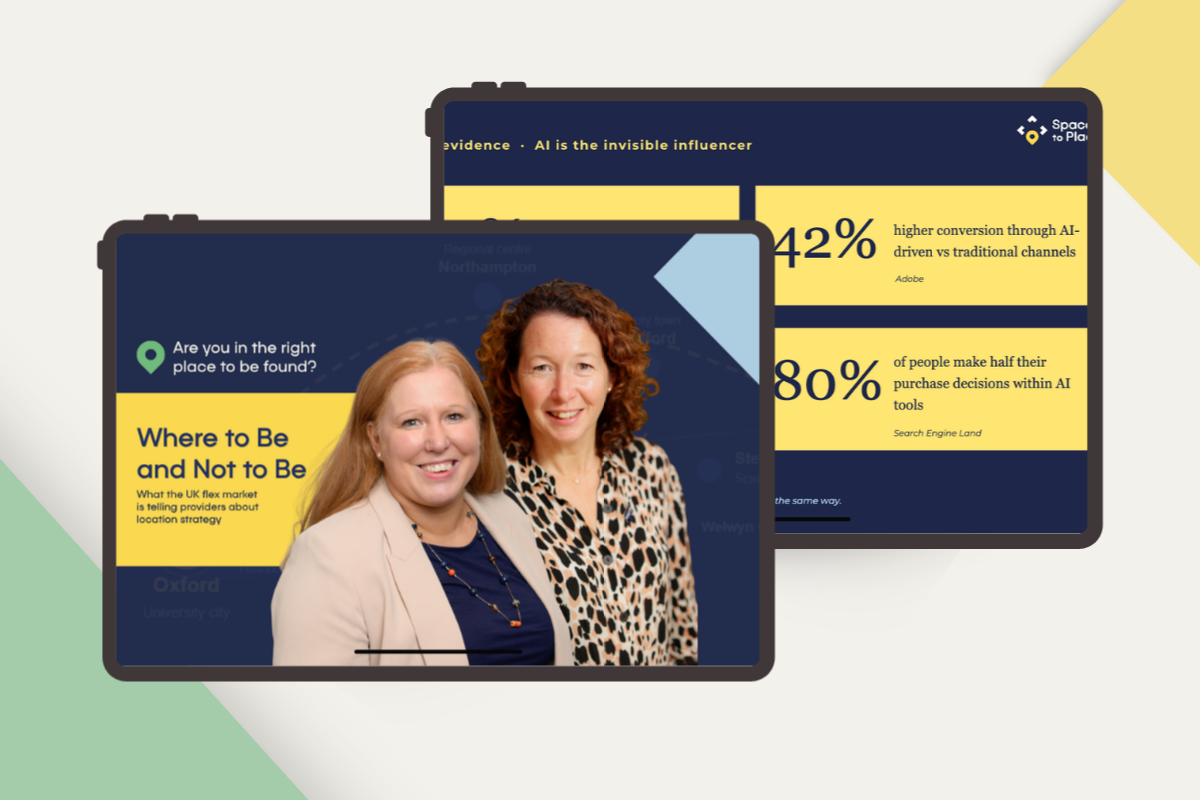

For years, flex space was often misunderstood. It was viewed as a niche offering for startups, freelancers, or businesses unwilling to commit to a traditional lease. That perception has changed, and the speed of change is accelerating. At the recent Operational Real Estate Summit in London, the conversation confirmed what our research has shown for some time: flex space has matured into a significant and growing component of mainstream real estate strategy.
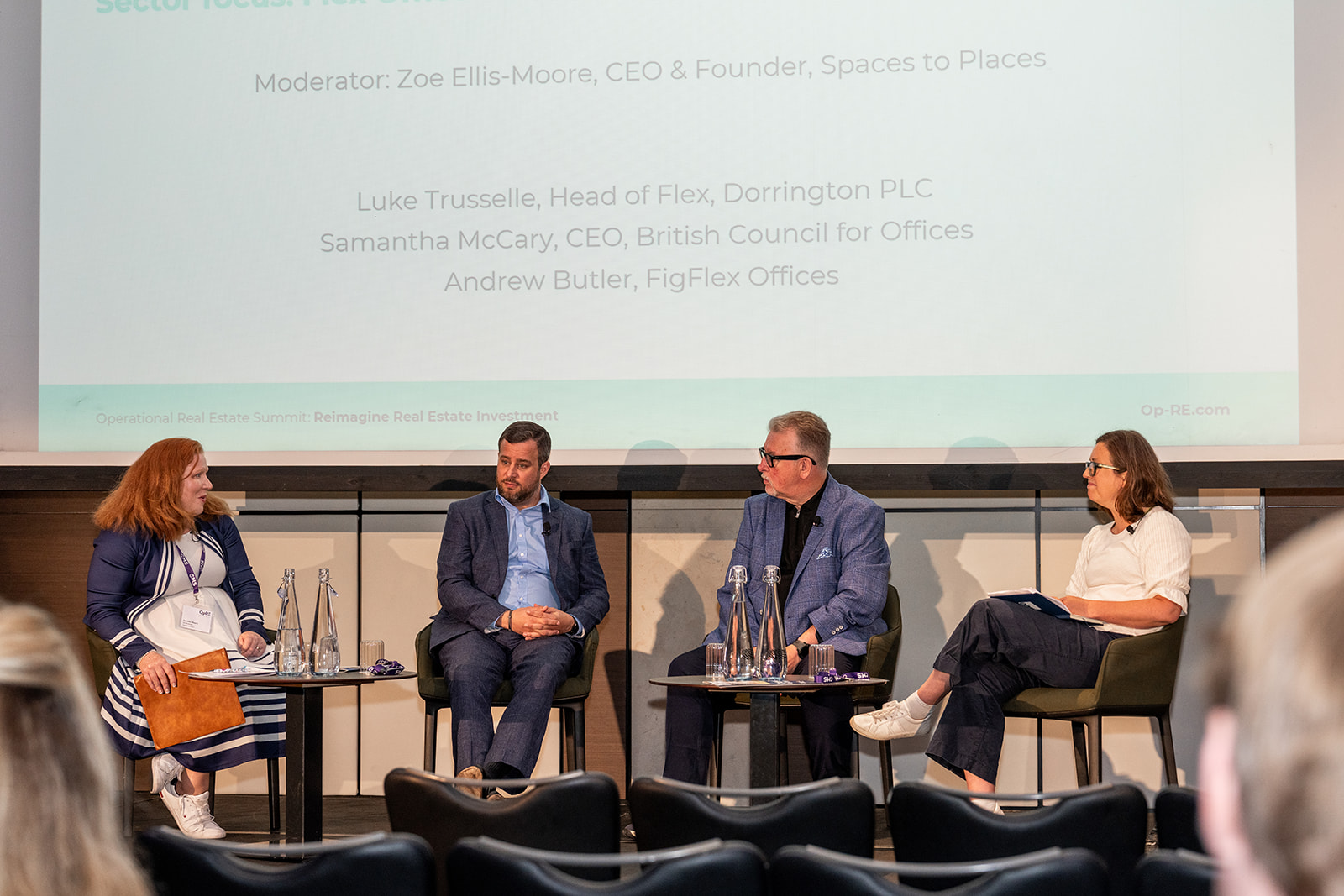
We moderated the flex office panel at the Operational Real Estate Summit on 23 June 2026 at Pullman London St Pancras, alongside Samantha McClary, Chief Executive of the British Council for Offices; Andrew Butler at FigFlex Offices; and Luke Trusselle, Head of Flex at Dorrington PLC. Four themes ran through the session: the sector’s evolution into a mature asset class, the shift from passive landlord to active operator, what retention actually depends on, and why data and benchmarking are now central to investment decisions.
From local business centres to strategic real estate
What began as local business centres and serviced offices with blue carpets and strip lighting has become a sophisticated workplace solution capable of supporting everyone from SMEs to multinational corporations. That is not spin. It is what occupier behaviour confirms.
Flexibility is no longer a fringe requirement. Businesses are operating in an environment defined by uncertainty, changing workforce expectations and rapidly evolving technology. As a result, occupiers are demanding more agility from their real estate portfolios. Flex space is no longer simply about shorter lease terms. It is about providing businesses with the ability to scale, adapt and access high-quality workplaces without the long-term commitments that traditional leasing models require.
Our UK Flex Market: From Hype to Operational Real Estate report tracks this evolution in detail. After years of inflated promises, the flex office sector has had its reality check. What has emerged is more durable: a service-led operating model with genuine occupier demand, improving retention rates and growing interest from institutional capital.
The rise of operational real estate
One of the most significant discussions at the summit centred on the growing recognition of flex space as an operational real estate asset class. Historically, investors have been comfortable valuing hotels, student accommodation and build-to-rent assets despite their operational complexity. Yet flexible workspace has often been viewed differently.
That is beginning to change. Providers are demonstrating that well-managed flex assets can generate stronger returns, higher occupancy and greater resilience than many traditional office investments. The focus is shifting away from simple occupancy metrics towards profitability, customer retention and operational performance. As more data becomes available and valuation methodologies continue to evolve, flexible workspace is increasingly being viewed through the same lens as other established operational real estate sectors.
Our UK Flex Market Business Models report, which analysed over 50 flex office providers with 10 or more locations, sets out the structural picture clearly. The sector is still fragmented, with hundreds of providers operating from single or dual-location portfolios. That fragmentation limits the economies of scale that drive profitability. The providers and landlords building towards genuine scale, or finding smarter ways to partner, are the ones capital is moving towards.
Customer experience is driving demand
A key shift over the past five years has been the growing influence of employees on workplace decisions. Historically, office choices were driven by senior leadership teams. Today, employee experience plays a much greater role, and occupiers are asking different questions before they commit.
- How easy is the commute for most of the team?
- Does the workspace support how we actually collaborate?
- Are sustainability credentials important to our people?
- What amenities are available
- Does the environment help us attract and retain talent?
These are conversations that providers across the panel are having every day with occupiers. The workplace is no longer simply somewhere people work. It has become a strategic tool for engagement, culture, productivity and talent attraction.
Our Voice of the Customer report surveyed office-based workers across the UK to understand what they actually want, rather than what the sector assumes they want. The findings reinforce what the panel described: the criteria occupiers apply go well beyond location and price, and a space that fails those criteria will not retain occupiers regardless of how well it performs on paper. Retention is a product problem, not a sales one.
Flexibility does not mean short-term
One of the biggest misconceptions about flex space remains the assumption that customers are constantly moving. In reality, many occupiers are staying significantly longer than people expect.
Businesses may initially choose a flexible workspace because they value optionality. But when the location, service, and environment support their growth, they often remain for multiple years. This creates a powerful dynamic for providers. Strong customer retention not only improves profitability but also demonstrates the stability that investors increasingly seek.
Perhaps the sector’s biggest challenge is that the term “flex” no longer fully reflects what many providers deliver. Increasingly, what businesses are purchasing is workspace as a service, and the product decisions that drive retention are operational ones: consistency of service, quality of environment, and the ability to scale within a building without disruption.
Brandlords are reshaping competitive dynamics
One of the clearest shifts in the market is how quickly established real estate players have moved in-house. Rather than viewing flex space as a third-party service, landlords are recognising its ability to enhance building performance, increase occupancy and create stronger occupier relationships. By integrating flexible workspace alongside traditional leasing, they are creating more vibrant and resilient assets.
FigFlex is a strong example. The brand is run by F1 Real Estate Management, which launched FigFlex in 2020 and has since grown its portfolio to almost 150,000 sq ft of flexible workspace across the UK, with turnover increasing by 600% since 2022. It is a direct illustration of an institutional real estate owner taking operational control and building a repeatable, scalable brand in the process.
Dorrington PLC takes a similar approach: running flex as an operating business within its portfolio, with measurable differences in occupier experience and retention that come from genuine operational intent rather than a fit-out decision.
Our London Flex Brand Index tracked this shift directly. Of the 60-plus London flex providers with four or more locations, 10 are now brandlords: established real estate players who have built in-house rather than outsourcing. That figure is growing. The commercial logic is sound: integrated flex improves whole-building occupancy, creates direct long-term relationships with occupiers and makes an asset more resilient when traditional leasing demand softens. But the operational gap is real. Landlords who treat flex as a fit-out decision will continue to underperform those who understand what actually drives retention.
AI will change operations, not human connection
AI inevitably featured in the discussion, as it does across every industry event right now. The panel took a measured view. AI will improve efficiency across sales, marketing, lead generation, and operations, and that is already happening in parts of the sector. But there was broad agreement that it will not replace the fundamental human need for connection.
Workplaces exist because people collaborate better together. The businesses driving innovation still need places where ideas are shared, relationships are built, and company cultures are strengthened. The more considered argument is that AI reinforces the case for quality physical space rather than undermining it. As more routine knowledge work becomes automatable, the activities that cannot be automated, collaboration, judgment, and relationship-building, become proportionally more valuable. AI may reduce operational costs and streamline processes, but it is likely to make high-quality workspaces more valuable, not less.
Looking ahead
The flex sector has spent years proving its relevance. That conversation is over. The question now is how large a role it will play, and the direction of travel is clear.
As occupiers demand greater agility, landlords seek stronger building performance and investors become more comfortable with operational real estate models, flexible workspace is moving firmly into the mainstream. For occupiers, it is access to workplaces that adapt as quickly as they do. For landlords and investors, it is an opportunity to create more resilient, customer-focused assets. And for providers, it is a moment to demonstrate that operational excellence, not just space, is the product.
Data sits at the centre of what comes next. Without consistent, comparable performance data, valuations remain contested and capital stays cautious. Those who invest in the operational and reporting infrastructure now will be the ones who shape the market over the next decade.
Our full research series covers the market from every angle. Start with UK Flex Market: From Hype to Operational Real Estate for the strategic overview, then explore the Voice of the Customer, the UK Flex Market Business Models report and the London Flex Brand Index for the detail behind the headlines.